
 Canadian

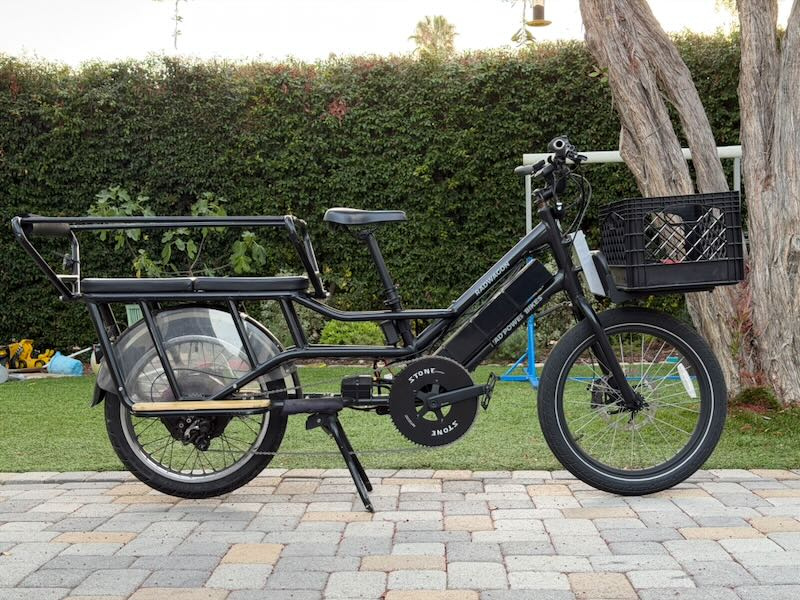
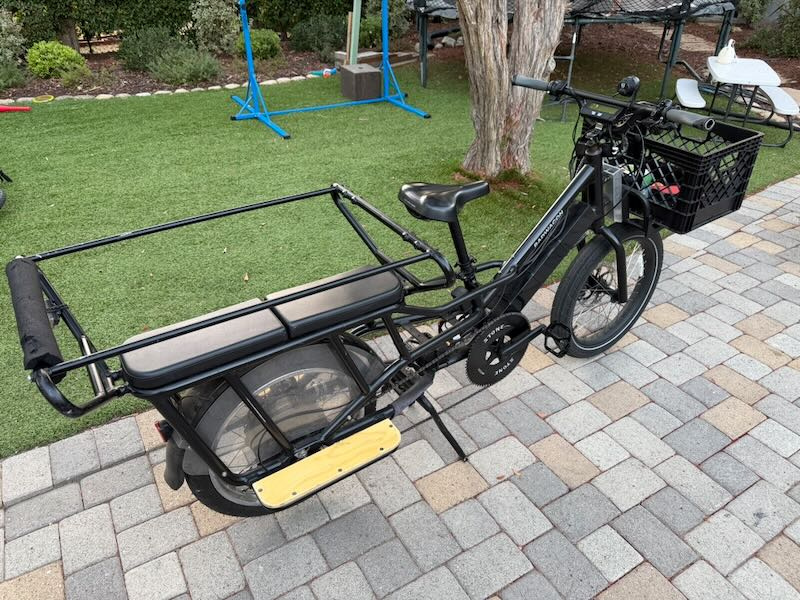
Radder Wagon: 4kw 72V Kid and Cargo Hauler
Santa Barbara, CA
|
43
Published: 2026-10-22
A link to my Endless Sphere post about this bike has additional insights in the comments section (link at end of this post).
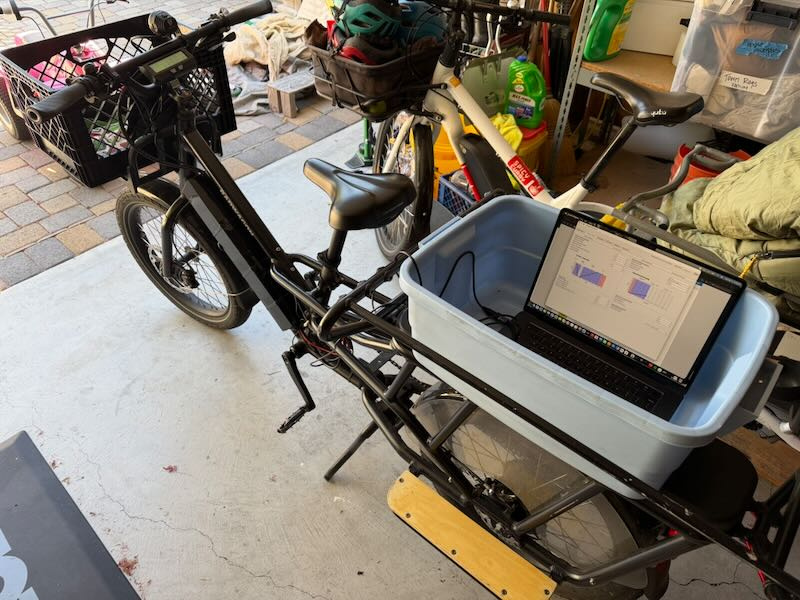
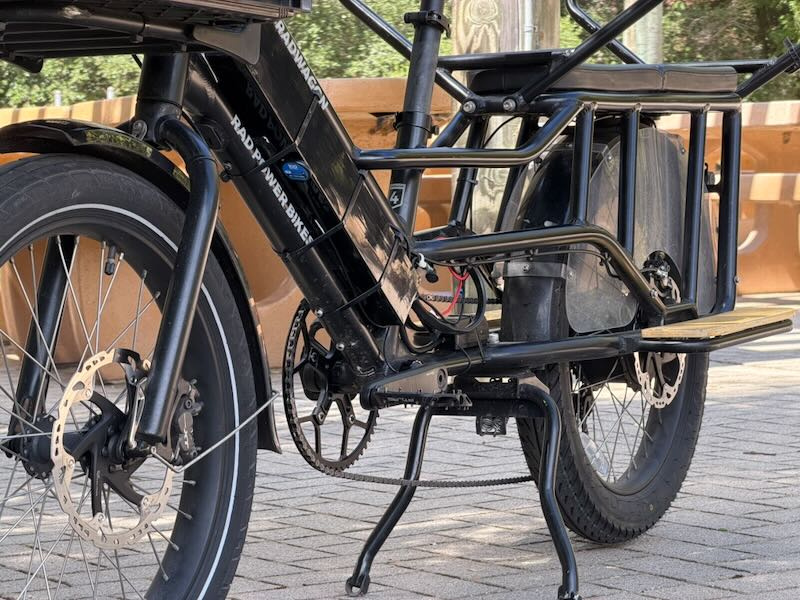
I started with a completely stock RadWagon 4 and wanted to turn it into a high-performance cargo bike while retaining its practicality. My goals were roughly 40 mph cruising, ~45 mph capability, strong hill climbing under heavy loads, torque-sensing pedal assist for a natural ride, regenerative braking, and—perhaps most importantly—very quiet operation.
I think the current bike weighs approximately 120 lb, although I have not weighed it yet, and has about 2,000 miles on the current setup which was completed 5 months ago or so.
Main components:
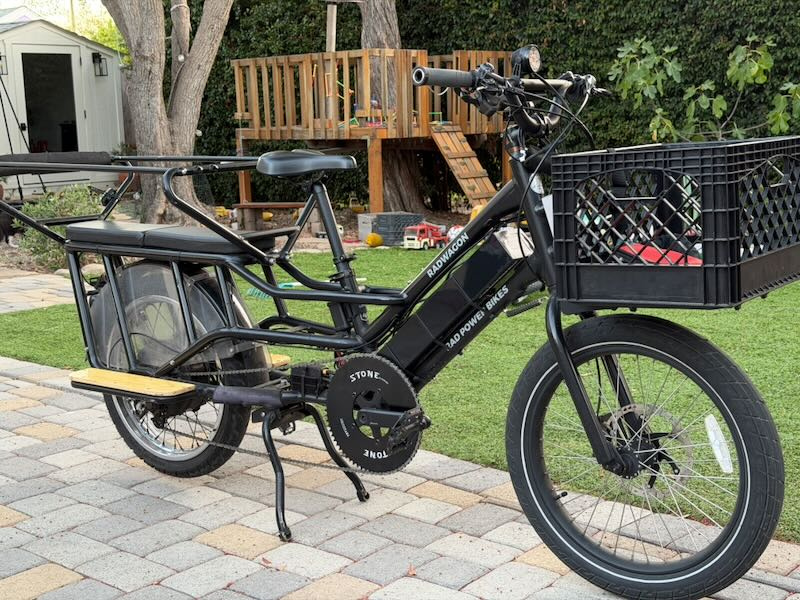
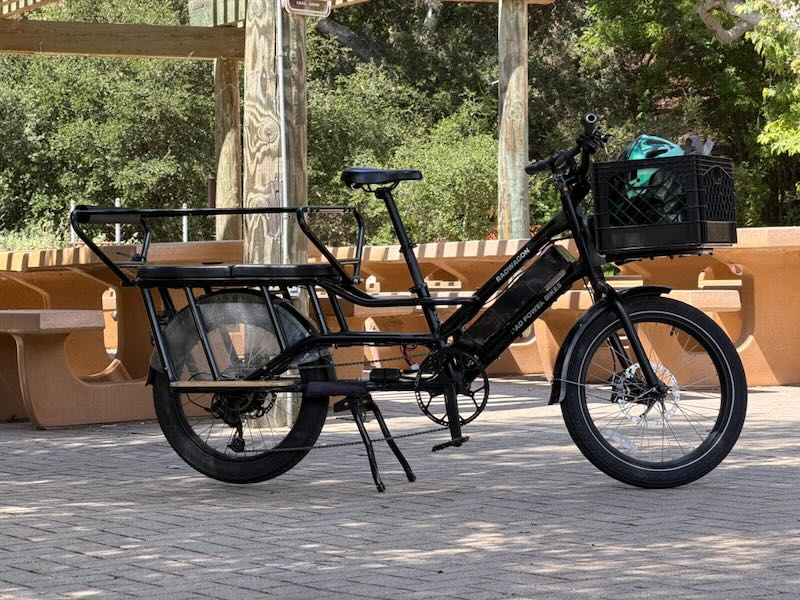
Bike: Rad Power Bikes RadWagon
Motor: Grin Max45, 36H, Standard winding, 12x178 adapter kit (with mods to fit Radwagon 10 x 175 dropouts)
Rear rim: Kawasaki Eliminator, steel 17 × 1.85, 36H
Rear tire: Michelin Pilot Street 2, 80/90-17, ~22.4" OD
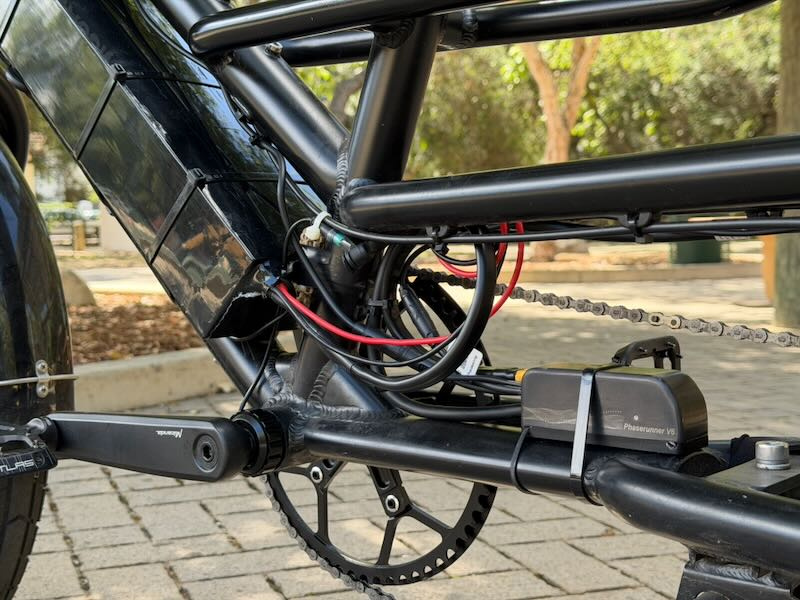
Controller: Grin Phaserunner V6
Display/control: Cycle Analyst 3
Torque sensor: eRider T-17, 83 mm
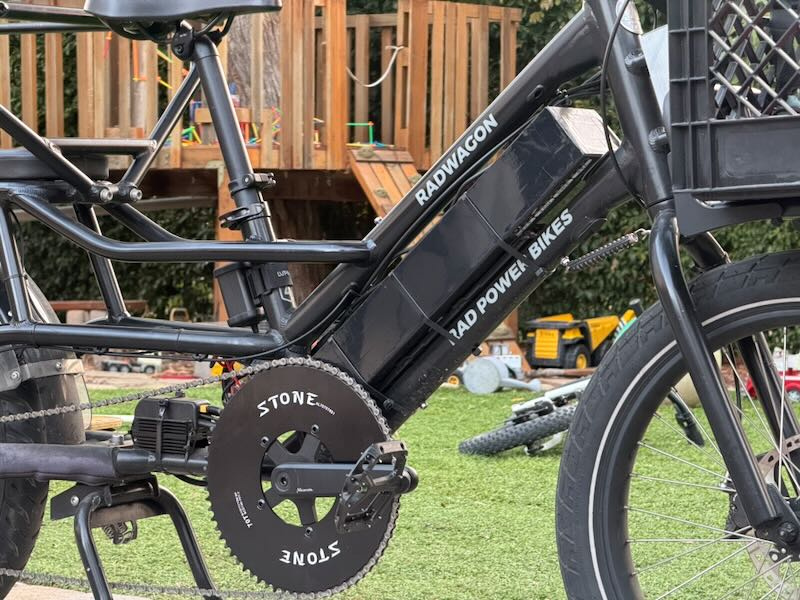
Battery: American Electric 20s4p, 20 Ah / 1,440 Wh, Samsung 50S
Battery current: 60 A
Phase current: 90 A
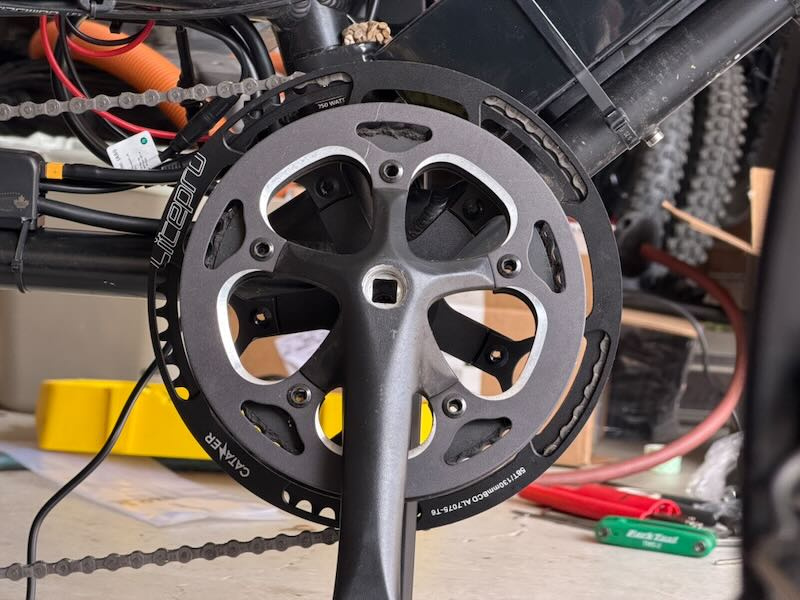
Drivetrain: Shimano Saint shifter/rear derailleur, 10-speed 11–25 Ultegra cassette, Stone 70T narrow-wide chainring
Brakes: Shimano XT M8020 4-piston, metallic pads
Rear light: Roxim
Front light: Lupine Betty, currently on its own 7.2 V battery
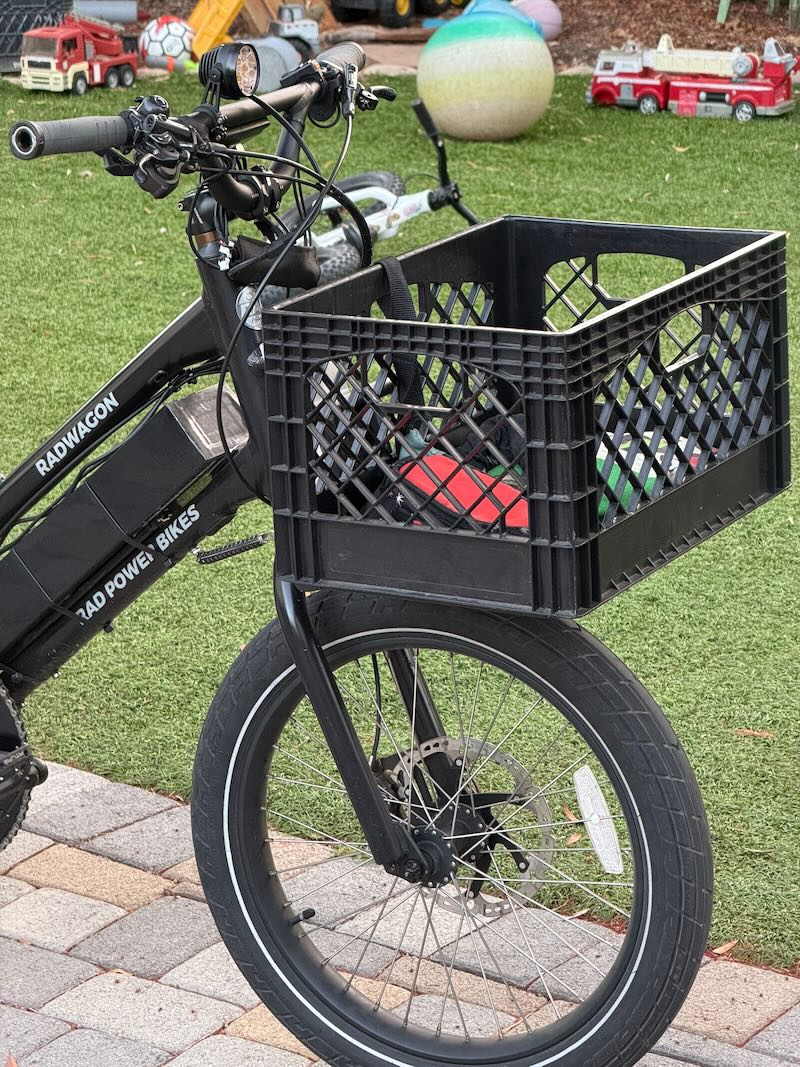
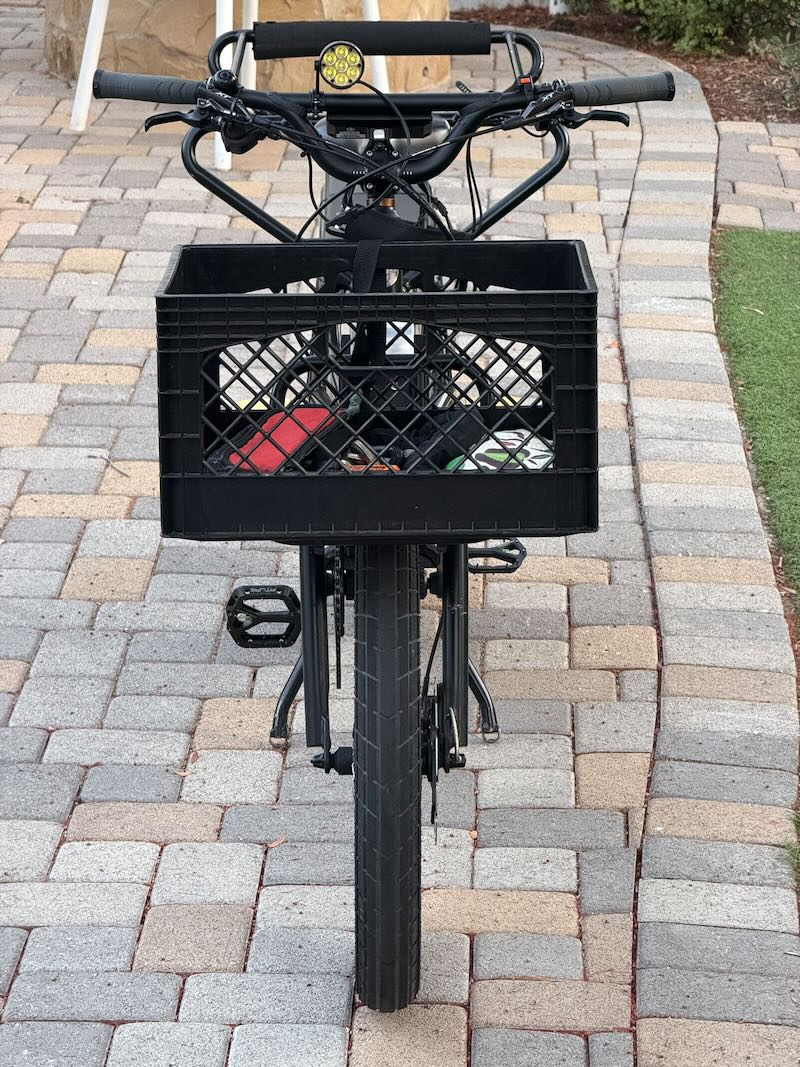
Front rack: Stock RadWagon flat front rack with lightweight milk crate basket (Modified: lowered 3 5/8 in)
Typical consumption: 40–50 Wh/mile
Typical range: ~25–30 miles
Cruising speed: ~30-40 mph
Target/useful maximum: ~45 mph
Additional Info
https://endless-sphere.com/sphere/threads/radder-wagon-radwagon-4-conversion-to-72v-20s4p-battery-grin-max45.131601/
Why I Built It
We are often traveling 5-10 miles each way for school drop offs and errands on roads with speed limits of 25-45mph and even on faster class 3 bikes like the Specialized Haul LT, the ride drags on far longer than is ideal on long straight sections of road and on hills that slow the bike down significantly. In town riding on 25-30mph limit streets is so comfortable on this bike, even with hills you can maintain the flow with traffic which I prefer and feel safest doing. I wanted torque sensing power delivery as I highly value a natural bicycle feel when riding.
Background
I’m always curious how people know so much on here and sometimes it’s hard to know where to really trust someone’s advice or opinion. I’ve been involved with bikes pretty seriously since I was an early teen and worked in a shop for years and have built hundreds (probably thousands) of bikes for retail. I raced downhill at the pro level for a number of years while I was getting my mechanical engineering degree which was nearly 20 years ago now. I designed suspension for Trek Bicycles and Fox Factory but have been out of the industry since 2018. I've probably ridden close to 100k miles on the road on rural and city streets and 50k miles off road mountain biking enduro and DH style trails.
Updated Phaserunner Controller and CA3 prior to Max45
I initially did a partial conversion while retaining the stock RadWagon Bafang geared hub motor. I deliberately didn't buy the Max45 initially because I wanted to see whether the stock motor would be adequate before spending the money on a much more substantial hub.
It wasn't.
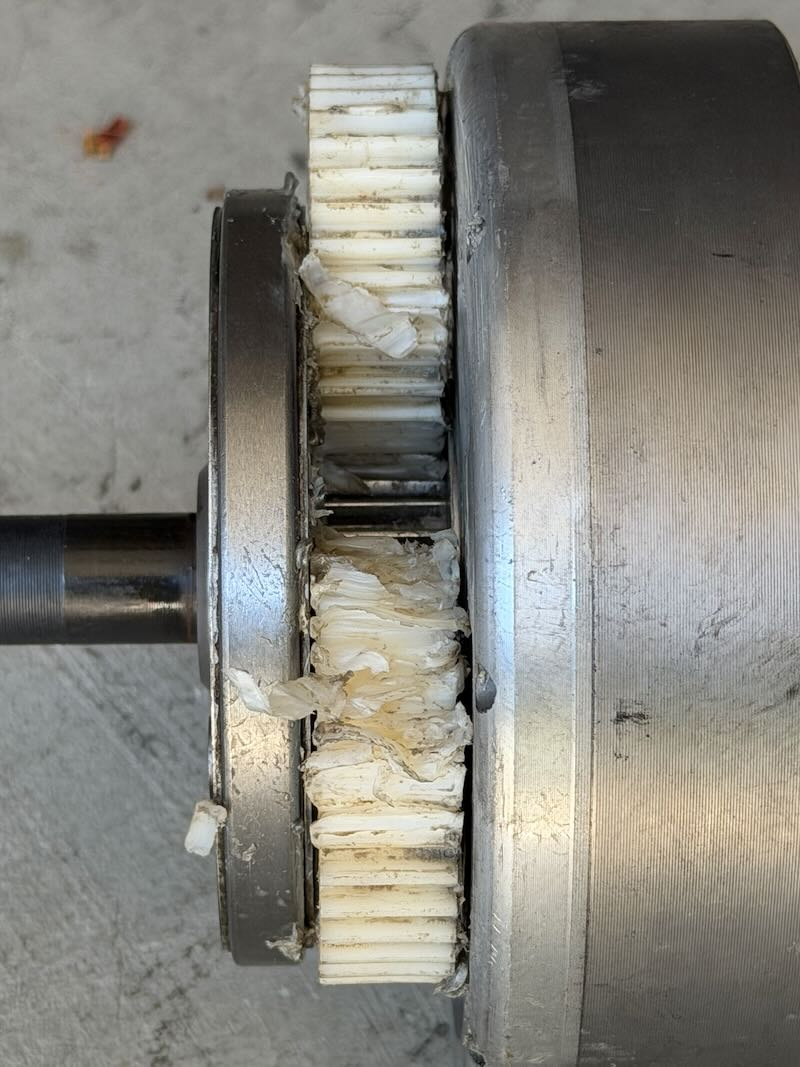
The Bafang couldn't sustain the power I wanted and eventually stripped its internal drive gears. I replaced the gears and continued running it at roughly 1,200–1,400 W maximum with no issues, but the motor was always audible and became extremely loud at higher speeds.
The noise was ultimately almost as important as the performance limitation. I ordered the Max45 relatively soon afterward because it offered substantially more sustained power and torque while being effectively silent.
I have become a big fan of direct-drive hub motors as a result. Even though a geared hub can have advantages for low-speed climbing, I don't think I would want to go back to one because I value the silent operation so much.
More Boost: Max45 Implementation and Rear Wheel Build Details
I chose the Standard-wind Max45 (~9 rpm/V) specifically to achieve approximately 45 mph with my 72 V system. Fitting the hub to the odd 10 x 175mm slotted dropouts on the Radwagon was not super straightforward.
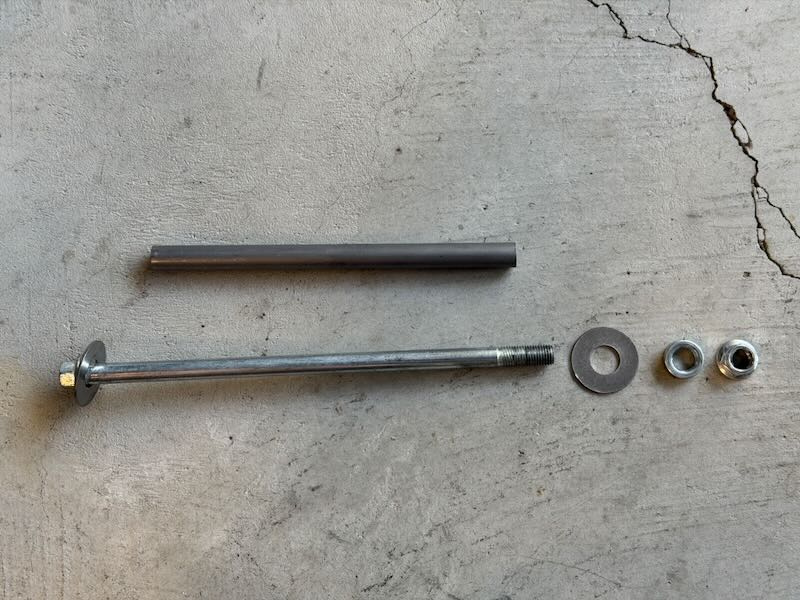
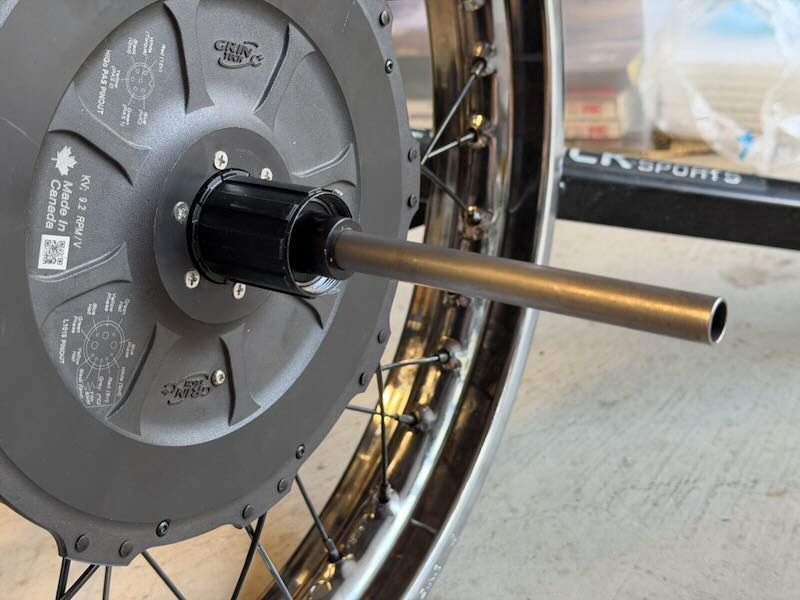
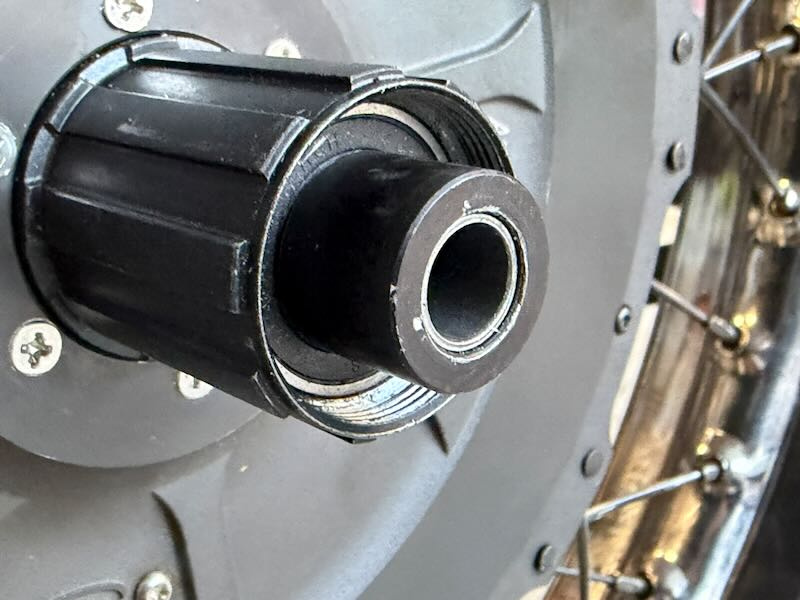
I am using the 12x178 axle kit from Grin and added the following mods to fit the wheel and align the brake caliper. I found 12mm x 1mm wall steel tubing from McMaster, so I cut a piece to about 174mm and lucky for me it slid right into the hub (with tolerances on the hub and tubing, it could result in interference). Then I had to “machine” off 3mm from the non drive hub endcap. I did this entirely with sand paper and my hands… I’m sure it’s not totally straight but doesn’t seem to be causing any issues. I also added a 1mm disc spacer to get the disk right at 15.5mm from endcap to rotor. You cannot add much more to the disk spacing or you’ll hit the torque arm.
I like 10 A of field weakening in normal operation. The purpose isn't really to increase my maximum speed which is capped at 45mph it helps maintain higher speeds farther into the battery's discharge range.
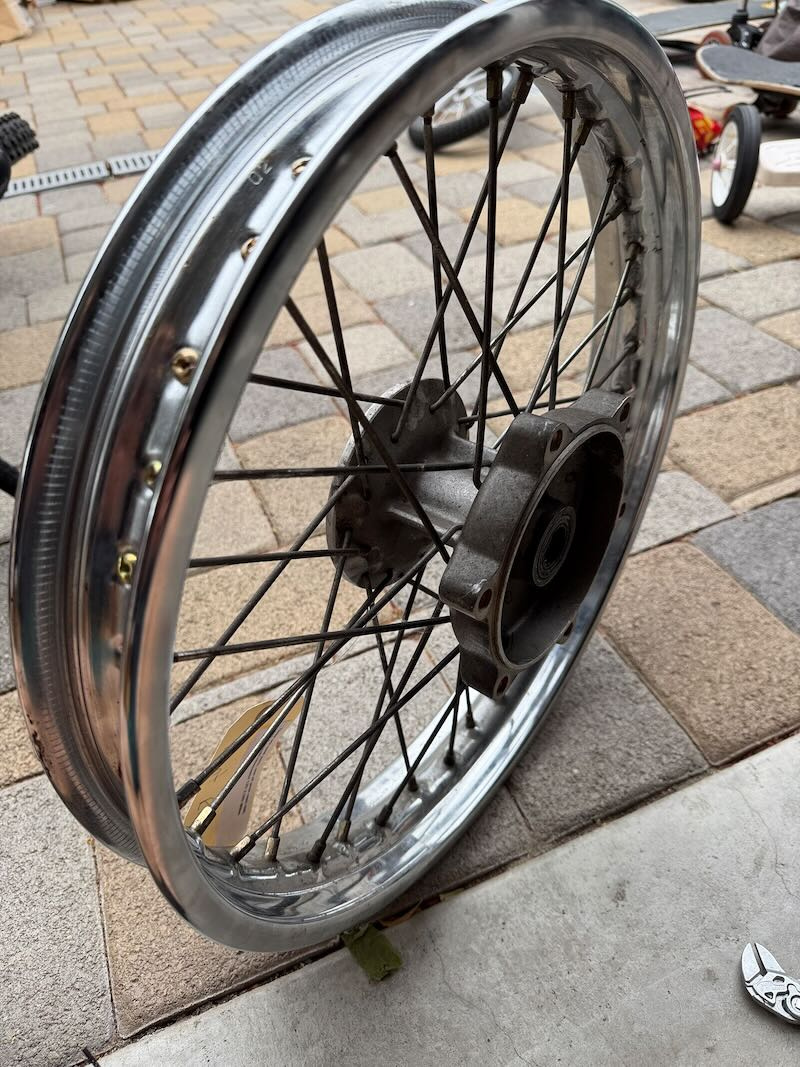
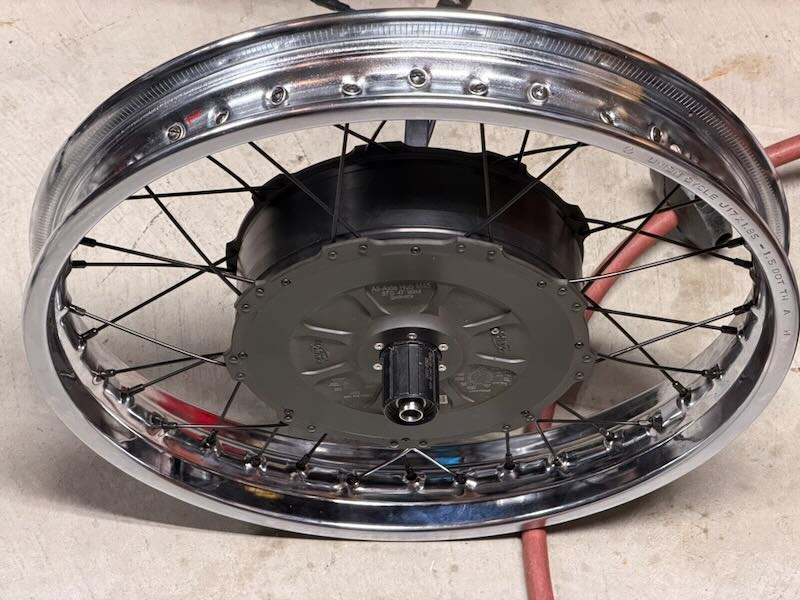
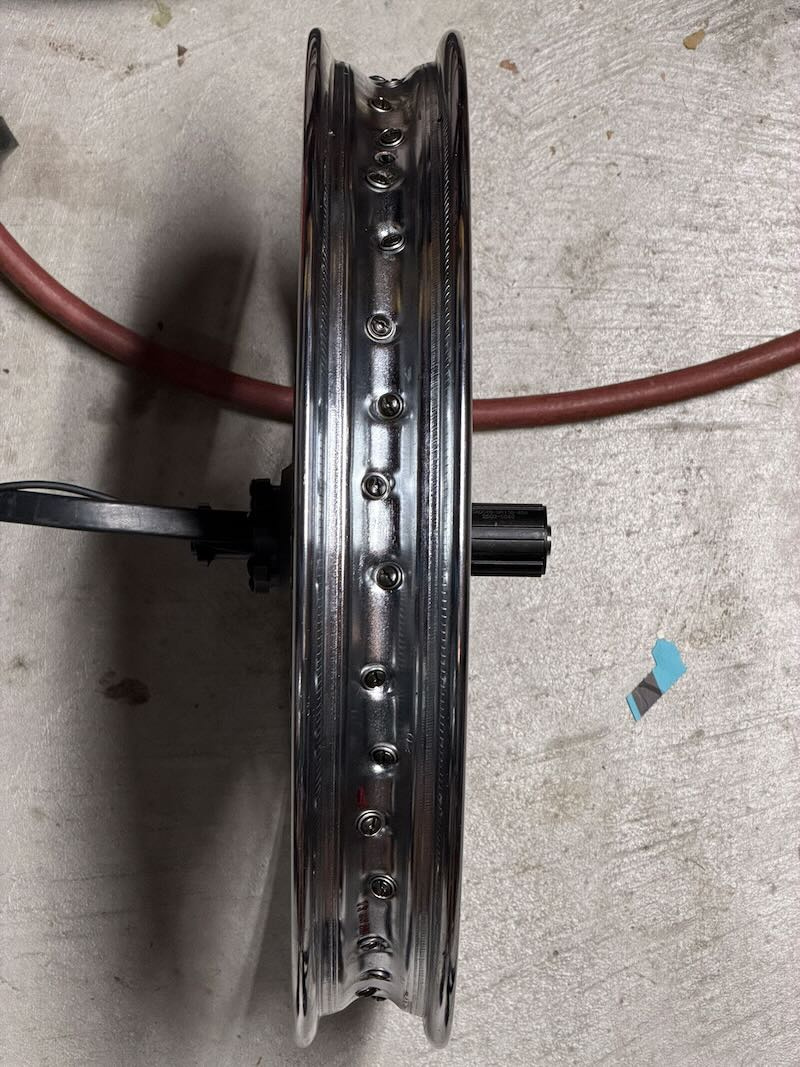
The Max45 is laced into a 36-hole Kawasaki Eliminator 17 × 1.85 motorcycle rim with a Michelin Pilot Street 2 80/90-17 tire. The resulting wheel is approximately 22.4" OD.
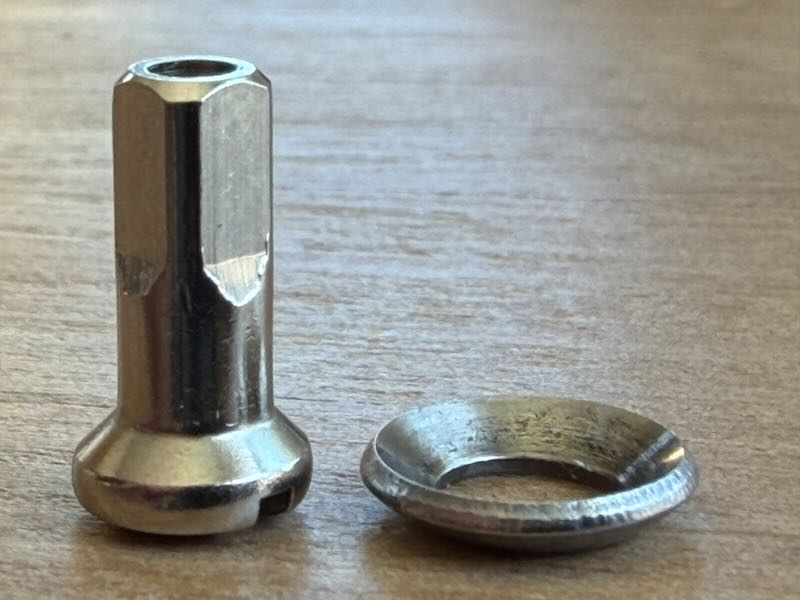
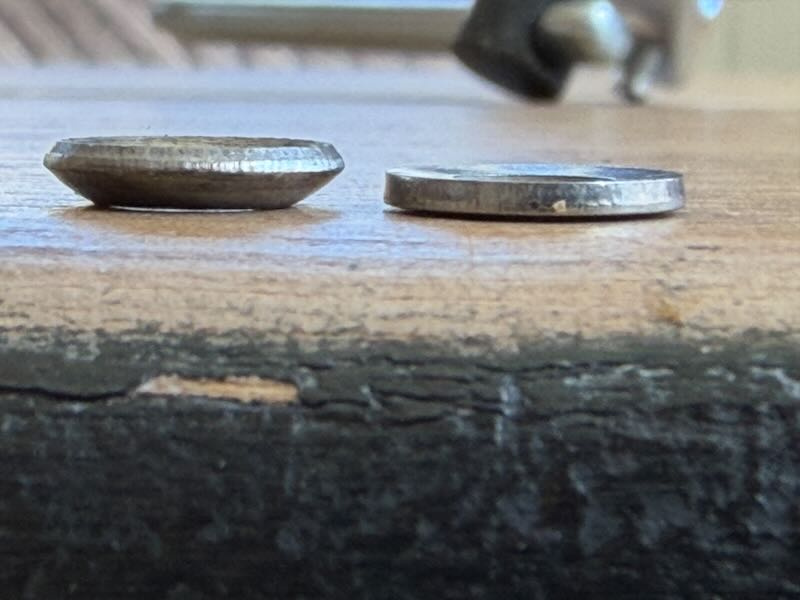
I got Sapim Strong spokes with the large nipples from Grin for the build, cut to 110mm drive side and 111mm non drive. I’m using 316 stainless M5 washers with the large 12ga nipples because the holes in the rim are about the same ID as the spoke nipple OD. I made the washer conical with a HVAC 45 degree tube flaring tool. Worked better than I thought! The washer material is critical though, it must be ductile enough to handle the deformation. I calculated the spoke length after measuring the rim and feel like I nailed the spoke lengths (measured way too many times but was happy it worked). One issue I ran into with the directional nature of the moto rim spoke holes was that they did not work at all with the Max45 when it arrived!! Enter panic mode….. long story short, I had to swap the orientation of the paired spoke holes on the hub, which required unbolting the side plate and rotating it to it’s other position and reinstalling. I had to get a gear puller from Orielly which made the job easy, I couldn’t get it off without the puller.
I chose the 17" motorcycle wheel because I was trying to go down on tire OD a bit and wanted something truly rated to carry significant loads. The ride quality is AMAZING. I cannot ride the thin sidewall bike tires on these cargo bikes. Even unloaded, the moto tire is far more damped than the bike tires. It feels SOLID and predictable. I had put an 18 x 2.75 moto tire on the stock radwagon rim before any of the other mods. I loved having that tire BUT the bead hook height on the stock rim is TINY. And the moto tire fit loosely on the rim. I rode it and liked the feel, but I cannot recommend that setup as I believe a huge hit from a pothole or turning while heavily loaded could have unseated the tire resulting in catastrophic blowout. The tire was so heavy it gave me the confidence to run it but the moto rim has a sideway about 10x the height of the bike rim, that tire aint ever coming off!
Battery
The battery is an American Electric 20s4p, 20 Ah / 1,440 Wh pack using Samsung 50S cells.
It gives me roughly 25–30 miles of real-world range, with typical consumption around 40–50 Wh/mile. If you rode a bit slower which I’ve done, you could get quite a bit more range. Riding around 30wh/mile is still faster than a traditional class 3 bike and provides significantly more range. If I had it to do over, I’d go bigger on battery. See the “next build” section at end as I’m already planning my second conversion. My wife and I both want one of these now as neither one of us wants to ride a second stock radwagon (we just bought it used with the intention of converting it).
I initially used a cheap charger with a 2.1 mm DC barrel connector. Even at only 4 A the connector became warm, so I replaced it with an Anderson PP30 and bought a Grin Satiator. The Satiator allows me to charge below the battery's maximum voltage when I don't need the full range, which I prefer for battery longevity. The PP30 connector seems to be working well for the hot swapping, although the data sheet only rates it for 100 cycles. There is a lot of arc damage on the tips of the connectors but per Anderson, this is by design and the critical contacting surface is left largely in tact.
I also had one memorable lesson while installing the PP30: I cut both battery wires simultaneously and got a pretty good spark. I was lucky not to damage anything.
Controller
The bike uses a Grin Phaserunner with:
60 A battery current limit
90 A phase current limit
Grin heatsink modification
Arctic MX-7 heatsink compound on all interfaces (just did this… so not much real world experience with maximum cooling in effect.
Installed in relatively good airflow to aid in cooling.
Cycle Analyst/Torque Sensing
The control system is built around a Cycle Analyst 3 which has been great except that it cannot run a powerful front light and does not do integrated brake signals to rear lights. Seems like a fairly significant shortcoming when the superharness which is a far less sophisticated product has these exact features (note I only recently realized this). I initially saw that CA3 seemed like the flagship Grin product and I love all the data it provides and for diagnostics while riding BUT the lighting outputs are severely lacking.
Pedal input comes from an eRider T-17 83 mm torque-sensing bottom bracket. These seem ok but because the spider attaches on such a small bolt circle diameter it is not complete perpendicular to the axis so the spider and chainring have a small lateral runout. I power the eRider from the Phaserunner's 5 V supply, which required some wiring splicing since another shortcoming of the CA3 is that it cannot power a torque sensor when running higher voltage batteries.
I am using a BB torque sensor instead of a cassette torque sensor because they feel so much more natural for power delivery than a cassette mounted sensor. I made a post about this so I won’t explain it here, but even with the BB sensor, power is over delivered at low speeds. With a hub mounted torque sensor, this behavior is many times worse. In the same assist setting the bike would provide full 4kw power at slow speeds and then at 40mph in high gears it would delivery roughly 1/3 that power due to the mechanical disadvantage of being in the small cog in the back. Meanwhile, aerodynamic drag would be slowing the bike down substantially at those higher speeds.
Drivetrain
The drivetrain is mostly a collection of Shimano components I already had from my DH racing days:
Shimano Saint shifter
Shimano Saint rear derailleur
10-speed 11–25 Ultegra cassette
Stone 70T narrow-wide chainring
The Stone chainring has been particularly good. It looks and feels very well made and has been completely trouble-free through approximately 2,000 miles. The clutch on the derailleur keeps the chain well managed.
I went with Shimano cassette with 11t small cog due to cost and durability. Running a smaller rear cog with the sram cassette body would have resulted in a more expensive hub with torque sensing as that’s all they sell it with with AND the cost of the cassettes is much higher. I also already had the entire drivetrain, so the actual cost difference was a lot. The 70-11 combo cruises at 90rpm at 40mph, which is faster RPM than I’d like but is totally doable. It feels perfect if I have the assist on a low setting (like 4-8x human power), but if you’re tired and just want to cruise with little effort (12-16x human power), then 70-80 RPM feels more comfortable to my wife and I.
Brakes
I use Shimano XT M8020 4-piston brakes with metallic pads (again, I had these). I would go up on power if I could to something like a Maven with 2.3 x 220mm rotors. I might try thicker/larger rotors in these even though they’re designed around 1.8mm to see if it works.
I would prefer larger/more substantial brakes for this bike, potentially with 2.3 mm rotors or lightweight motorcycle brakes. In practice, however, I almost never use the mechanical brakes because regenerative braking handles nearly all of my normal slowing and stopping. While I would never say never, I use regen for 95% or more of my stopping. It’s gotten to the point that I actually have to use the brakes occasionally or they get covered in moisture or contaminants and they just don’t have full power when you pull them, because I’ll go days without actually using the brake pads to slow down or stop.
Regenerative Braking
The current system uses a Grin magnetic brake sensor to activate regen, with the regen level modulated through the throttle.
It works, but it isn't particularly natural because slowing with regen requires the left thumb while the right hand operates the brake lever.
I am leaning toward superharness for my next build as it offers a dedicated analog regen input and I believe I can piece together a throttle hall sensor on the right rear brake lever and get full regen modulation out of the free stroke of the rear brake, then additional braking from engaging the brake pads. Really excited about this as I love the regen behavior but it’s not as seamless as I or my wife would like.
Front Cargo Rack
I modified the stock RadWagon "pizza" rack by adding a piece of 3/16" × 1.5" × 3" aluminum rectangle tubing, lowering the rack 3 5/8in. It’s lowered by the distance between the two mounting bolts as I put the top rack bolts into the bottom mounting holes with the adapter. The 1.5" further forward position of the rack is important to clear the fork crown when turning the bars 90 degrees. I wanted to keep the rack closer to the bike but then couldn't lower it as much, so it's a bit of a compromise. I really want to design a custom rack to get even lower and closer to the bike... but I have 0 equipment to fab anything and am certainly not going to pay a hefty price to have someone make one.
I appreciate and can notice the lower center of gravity and it gives better clearance around the handlebars and lights for cargo to fit into the basket, which we use a TON.
I use a lightweight Walmart milk crate that weighs approximately 3–4 lb. It's somewhat flexible but has been strong enough for anything I'm willing to carry in it, including groceries, RC cars, beach toys, backpacks, and miscellaneous cargo.
Lighting
The rear light is a Roxim from Grin, selected because it can operate directly from the bike's ~84 V maximum battery voltage. It works well but isn't as bright as I would ideally like.
The front currently uses a Lupine Betty on its own dedicated 7.2 V battery.
My next lighting modification is to eliminate the separate Lupine battery and run the front lighting from the main traction battery through a DC-DC converter, which I have, but I need to sort out a switch and fuse for it.
Performance
The bike cruises comfortably just under 40 mph, which feels about as fast as I want to travel routinely.
I like having approximately 45 mph available on roads with 45 mph speed limits when the bike lane doesn't feel safe. Being able to flow with traffic is much preferable to riding substantially slower than surrounding traffic in those situations.
Field Weakening / No-Load Testing
At approximately 76 V battery voltage:
Field weakening Power Current No-load speed
0 A 145 W 1.85 A 46 mph
10 A 176 W 2.4 A 51 mph
15 A 220 W 3.0 A 54 mph
These were no-load tests and aren't representative of road-load power requirements. The bike can supply decent power about 4-5mph slower than these no load speeds, which is why I still run some field weakening to maintain 45mph capability since even at 76V battery, you can’t go that fast unless you’re going down a pretty big hill.
Hill Climbing and Thermal Limits
The most revealing test I've done was a roughly 10% grade with my kids on the back, at approximately 425 lb gross vehicle weight (sort of a guess, but I’m probably fairly close).
The Phaserunner hits thermal rollback relatively quickly. This is the only logical rollback that I should be hitting but I haven’t 100% confirmed this. The battery and motor all show normal temps and no warnings, which pretty much just leaves the controller though, so I’d say I’m like 95% sure it’s rolling back. Power initially reaches roughly 3 kW, then rapidly falls toward 700 W, at which point the bike becomes very slow.
This isn't a hill I encounter frequently, so it isn't a major limitation for my normal riding, and also isn’t nearly as formidable with lower cargo weight. However, it illustrates the importance of motor winding selection for someone who regularly rides steep hills.
The Grin Motor Simulator estimates approximately 10 mph sustained speed for my current setup under those conditions with a HOT controller. Switching to the Max45 Slow winding would roughly double the simulated sustained speed to 20 mph. I didn’t run enough of these simulations prior to deciding on the standard wind. When you use the COLD controller settings, the std wind appears to have no drawback to the slow wind, and goes much faster. Well, hill climbing is the drawback of the standard wind.
For someone who spends a lot of time climbing, I would therefore choose the Slow winding and/or a geared hub motor.
For me, however, the silent operation of the direct-drive Max45 is worth the tradeoff. I don't think I could go back to a geared hub even if it provided better sustained hill performance.
Build Lessons
The stock RadWagon Bafang hub was not suitable for the power I wanted.
Direct drive is exceptionally appealing for a high-performance cargo bike because of how quiet it is.
Motor winding selection has a huge effect on sustained hill performance if your controller cannot provide infinite amounts of phase current.
Controller thermal capacity can become the limiting factor even when the motor itself has considerably more capability.
Torque sensing makes a high-power cargo bike much more controllable and natural to ride.
Regenerative braking can handle a surprising amount of normal braking.
Cheap charging connectors are not necessarily adequate for high-current charging.
Don't cut both battery wires simultaneously.
A lower front rack makes a surprisingly noticeable difference to the handling of a heavy cargo bike.