
 Canadian
Why Hub Motors
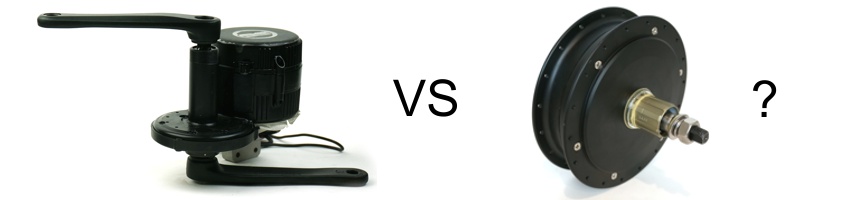
Hub Motor or Mid-Drive?
When you convert a bike to electric assist, one of the first choices is between a hub motor, which builds the motor into a wheel, and a mid-drive, which mounts at the bottom bracket and sends its power through your chain and gears. Both are good technologies, and neither is universally better. The right one depends on how and where you ride. We build hub motor kits because they suit the majority of our customers, but there are real situations where a mid-drive is the better tool, and we will be upfront about both.
When a Mid-Drive Wins
There are clear cases where a bottom-bracket mid-drive outperforms a hub motor:
- Technical off-road and mountain biking. The motor weight sits low and central on the frame rather than out at a wheel, so it barely affects handling, even on full-suspension bikes. On slow, steep, technical climbs, a small motor working through the bike's low gears is extremely efficient.
- Fat bikes in sand or deep snow. These are low-speed, high-resistance conditions, and running the motor through a low gear moves heavy loads through soft terrain more efficiently than most hub motors can, while still doing fine at road speeds.
The common thread is low-speed, high-resistance riding where gearing the motor down really matters. If that describes most of your riding, a quality mid-drive like the Bafang BBSHD is worth a serious look.
When a Hub Motor Wins
For most people, though, an ebike is for daily riding: commuting and getting around on roads and paths, where the goal is to hold a comfortable, steady speed regardless of the hill grade. In that setting a mid-drive offers almost no advantage, while a hub motor gives you a simpler, quieter, lower-maintenance bike. That is the bulk of who we serve, and it is why we have focused on hub motor systems since we first began working with the Crystalyte motors in 2003.
The rest of this page covers the specific advantages that make hub motors such a strong fit for everyday riding. This is not about declaring hub motors universally superior; it is about giving the hub motor side of the story, which often gets lost in online discussions.
Hub Motor Advantages
1) Propulsion that does not depend on your chain
A hub motor drives the wheel directly, so it does not rely on your chain and gears to move the bike. If a chain breaks, a derailleur jams, wet snow packs into the sprockets, or a freewheel fails, the motor can still get you home. With a mid-drive, anything that takes the drivetrain out of commission stops the bike entirely, because both the motor and your pedaling drive through it.
2) Less wear on your drivetrain

Because a hub motor takes on much of the work, it lowers the pedal effort running through your chain, cogs, and derailleur, so the drivetrain lasts longer. A mid-drive does the opposite: it adds the motor's power on top of your own through those same parts. A bike drivetrain can handle that, but it wears noticeably faster and needs closer attention to chain stretch, cog wear, and shifter alignment.
3) You can use an internal gear hub

Compact internal gear hubs (7 to 14 speeds, with wide ranges) are one of the nicer developments in bike hardware, but with a couple of exceptions (Rohloff and the original NuVinci) they are not rated for the extra load of a motor and tend to wear out quickly with more than a couple hundred watts running through them. A front hub motor sidesteps this completely: the motor is on one wheel and the internal gear hub on the other. Pairing an internal gear hub with a mid-drive is risky unless that hub is explicitly rated for tandem or cargo use, and most are not.
4) Higher peak power
Your chain and gears also cap how much motor power you can safely put to the ground. Up to roughly 750 watts is usually fine, just with faster wear. But once you are after multiple kilowatts, a mid-drive starts snapping chains, shearing freewheels, and breaking spokes. A hub motor with a properly fitted torque arm has no such limit, which is why serious high-power builds are hub-driven.
5) Regenerative braking
 A direct drive hub motor (or a geared hub with a locked clutch) can act as a smooth, controllable brake that is unaffected by rain, pad wear, or cable adjustment. Much as it reduces chain wear, it cuts brake-pad wear too: you can do most of your braking electronically and save the pads for hard stops. A mid-drive has essentially no path to regen, since it would have to drive backward through the freewheel in your drivetrain.
6) Simple installation
Bottom-bracket mid-drives are not hard to install if you have the bottom-bracket and crank tools, but nothing is easier than a front hub motor: you take off the original wheel and put the motorized one in its place. We would not lean on this too heavily, since install time is small next to the riding you get out of a kit, but if easy fitting and moving the assist between bikes matters to you, a front hub is hard to beat.
7) More torque-sensor options
 Because a hub motor keeps its propulsion separate from your pedaling, almost any pedal-input sensor can measure how hard you are working: chain-tension sensors, rear-dropout sensors, rear-axle sensors, and the many bottom-bracket torque sensors on the market. With a mid-drive, the motor and your legs both act through the same drivetrain, so those sensors cannot tell them apart, and you are limited to whatever sensing the system ships with. Some aftermarket mid-drives now include a torque sensor, but many still rely on a basic cadence sensor that only detects whether you are pedaling, not how hard.
8) No need to shift constantly
A mid-drive works best when you shift as you speed up and slow down, easing off the motor during each shift to protect the drivetrain. That constant shifting and backing-off gets tiring and costs a little speed. A hub motor delivers uninterrupted power through every gear change, so you can leave the bike in a comfortable gear and let the motor bring you up to speed. For riders who are not used to managing gears, that simplicity is a big part of the appeal.
Why We Don't Carry the Bafang Kits
We have tested the Bafang BBS01, BBS02, and BBSHD along with many other mid-drives over the years, and they simply have not been the right fit for most of our customers. A few reasons: the integrated controller limits your options for upgrades and repairs, the wide stance ("Q factor") needed to clear the motor can make pedaling feel awkward, and chainring choices have been limited. None of that makes them bad kits. They are just not where we choose to focus.
We did offer a mid-drive for cargo ebikes years ago, the Stokemonkey, now retired, so mid-drives are not foreign to us. We concluded long ago that hub motors serve the great majority of riders better, and we have built our lineup around them ever since.
Ready to Choose a Hub Motor?
If a hub motor sounds like the right fit for your riding, here is where to go next:
- Compare the options. The Hub Motor Options guide lays out our full lineup side by side, from the light geared kits to the All-Axle.
- Browse the kits. Have a look at our Grin All-Axle kits or the full range of other motor kits to put together a complete conversion.
Hub motors have kept improving in power, efficiency, and bike compatibility since they first became popular in the mid-2000s, and for everyday riding we still think they are the best way to electrify a bike.