
 Canadian
Hub Motor Options
There are a lot of hub motors to choose from, but it really comes down to three things: geared or direct drive, front or rear, and enough torque for the hills you ride. Below you'll find the full lineup compared side by side, with a detailed write-up on each, and we're always happy to help you narrow it down if you get stuck.
Compare at a Glance
The Grin All-Axle is our flagship, and it outsells every other motor combined. Here is the full current lineup at a glance, grouped by type with the direct drive motors first; a detailed write-up on each follows below. Torque is shown as a rough tier, since the exact figure depends on your controller and battery.
| Motor | Type | Torque | Weight | Regen | Best for |
Grin All-Axle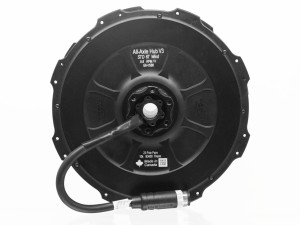 |
Direct drive | High | 4.0-4.3 kg | Yes | Fits nearly any bike; about 2 kg lighter than other direct-drive hubs; rear has an integrated torque sensor |
Max45 All-Axle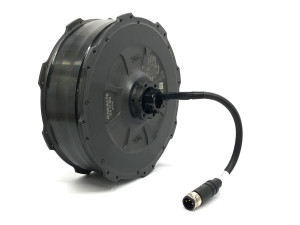 |
Direct drive | Very high | 6.0-6.3 kg | Yes | Fatbikes; the most torque and power |
Nine Continent FH212 / RH212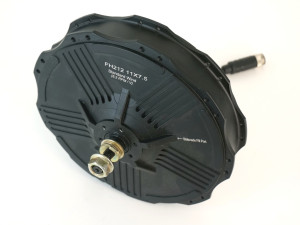 |
Direct drive | High | 6.5 kg | Yes | Value direct drive; heavier |
Crystalyte SAW20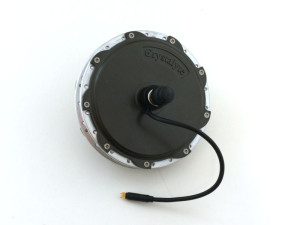 |
Direct drive | Low | 3.2 kg | Yes | Folding bikes (Brompton) |
Bafang G310 / G311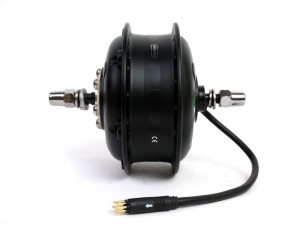 |
Geared | Low | 2.55 kg | No | Lightest and most discreet; modest assist |
Shengyi SX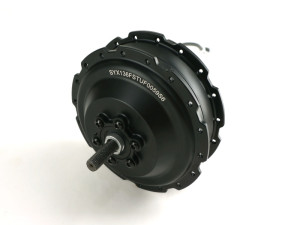 |
Geared | Medium | 3.0 kg | No | Light, a little tougher than the G310/G311 |
eZee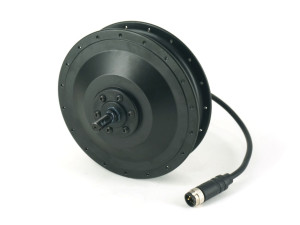 |
Geared | High | 3.8 kg | Front option | Powerful geared motor for hills and cargo |
GMAC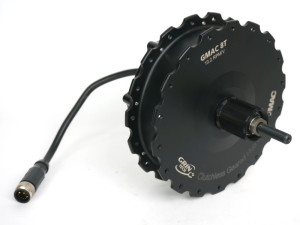 |
Geared | High | 3.8 kg | Yes (locked clutch) | Strong torque plus regen in a geared hub |
Bafang G62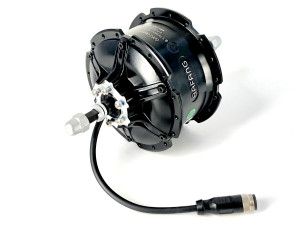 |
Geared | High | 4.95 kg | No | Fatbike (geared) |
The All-Axle is by far our most popular motor, and it fits the widest range of modern bikes. For a lighter, more discreet setup, the geared Bafang G310/G311 and Shengyi SX are the smallest options, while the more powerful geared GMAC and eZee are built for hills and cargo. The main trade-off between the two families is how they coast: geared motors freewheel with no drag but generally can't recover energy, while direct-drive hubs like the All-Axle give you regenerative braking and near-silent running in exchange for a little drag when coasting. Among the direct drive motors, the lower cost Nine Continent FH212/RH212 is heavier and now sees less demand, though it still has its place.
In addition to these common options, we also have a number of specialized kits for niche applications; such as the SAW20 with 75mm axles for folding bikes, Wheelbarrow motors for material moving, and the G62 motor for fatbike conversions with 170-195mm rear dropouts. For a detailed list on what motors would be compatible with your particular bike frame, have a read of our Bike Compatibility Guide. Here’s a summary breakdown of the current packages that we've put together at Grin.
Grin All-Axle
| Motor Weight | 4.0 kg |
| Typ. Power | 500-1000 W |
| Torque | High |
| Motor Type | Direct Drive |
| Mounting |
Front and Rear |
Grin All-Axle Kit: The All-Axle is our most popular motor by a wide margin, and it fits almost any modern bike. It's one of the only hub motors natively compatible with thru-axle dropouts, and a wide selection of axle inserts covers nearly every quick-release and thru-axle standard, front or rear. It's also over 2 kg lighter than comparable Chinese direct-drive hubs, so you get the smoothness and regen of direct drive without the usual weight penalty, and the rear version adds an integrated PAS and torque sensor to simplify installation. We design and build it in-house at our Vancouver shop and back it with a 3-year warranty. See the All-Axle hub page for full details.
Max45 All-Axle
| Motor Weight | 6.0 kg |
| Typ. Power | 750-2000 W |
| Torque | Very high |
| Motor Type | Direct Drive |
| Mounting |
Front and Rear Fatbike |
Grin Max45 All-Axle: This is the big cousin of our All-Axle hub motor, with a wider 45 mm internal motor width that raises its torque and power capability by about 66%. In most builds it's the motor controller, not the motor, that sets the ceiling, so that extra headroom really comes into play in high-power or specialty setups where the motor can be driven much harder than our standard kits allow. Its width means it won't fit a normal bike frame, but it's a perfect match for fatbikes, which use 135-150 mm front forks and 170-197 mm rear dropouts, and we have adapters for all of those standards. There's also a Max45 single-speed version that fits a 135 mm frame for setups that don't need a rear gear set. It shares the All-Axle's thru-axle compatibility, regen, and in-house build; see the All-Axle hub page for details.
FH212 / RH212 Kit
| Motor Weight | 6.5 kg |
| Typ. Power | 600-1200 W |
| Torque | High |
| Motor Type | Direct Drive |
| Mounting |
Front and Rear Slotted Dropouts |
RH212 FH212 Kits: This is the most affordable way into a direct-drive motor. Made by Nine Continent, it gives you the direct-drive essentials, regenerative braking, near-silent running, and no internal gears to wear out, at a lower price than the All-Axle. It fits standard front and 135 mm rear dropouts, uses a modern cassette freehub so it works with today's drivetrains, and has clearance for disc brakes, with a deeper stator and higher pole count that give it solid torque for its class. The main trade-off is weight: at around 6.5 kg it's noticeably heavier than the All-Axle, so most riders now spend a bit more for the lighter motor. But if price is the priority, the 212 still delivers. See the H212 info page for more details.
Crystalyte SAW20
| Motor Weight | 3.2 kg |
| Typ. Power | 250-500 W |
| Torque | Low |
| Motor Type | Direct Drive |
| Mounting | Front Only |
SAW20 Kit: The Crystalyte SAW20 is a small direct-drive motor for folding bikes, sized for the narrow 75 mm forks they use. Being direct drive, it runs silently and can do regenerative braking, a nice fit on a compact commuter, and while it's larger in diameter than a geared mini it keeps a narrow profile. We offer it prelaced in a 16 inch (ETRTO 345) wheel for Brompton bikes, and in a 20 inch version for folders like the Dahon and TERN. See the Brompton kit page for details.
Bafang Mini Geared G3 Series
| Motor Weight | 2.55 kg |
| Typ. Power | 250-500 W |
| Torque | Medium |
| Motor Type | Geared |
| Mounting |
Front / Rear |
Bafang G311 / G310 Geared Kit: These are the smallest and lightest motors we offer, well suited to riders who want a modest, discreet level of assist. Being geared, they freewheel when you are off the throttle, so there is no drag when coasting, and at only about 2.5 kg they barely change how the bike handles. The G310 is a rear cassette motor, and both it and the front G311 use nearly silent helical gears with a high reduction ratio. See the G310/G311 product page for more details.
Shengyi SX Series
| Motor Weight | 3.0 kg |
| Typ. Power | 250-500 W |
| Torque | Low |
| Motor Type | Geared |
| Mounting |
Front / Rear |
Shengyi SX Geared Kit: These are geared front and rear hub motors, a small step up from the Bafang G310/G311: a bit larger and heavier, but built to handle somewhat higher power and speed. Like the Bafang, they freewheel and use silent helical gears, and the sturdier build gives them more headroom before overheating and better tolerance of high RPM. A good middle ground when you want more than the smallest kits. See the Shengyi SX product page for more details.
eZee
| Motor Weight | 3.8 kg |
| Typ. Power | 600-1200 W |
| Torque | High |
| Motor Type | Geared |
| Mounting |
Front and Rear |
eZee Kit: The eZee is our most powerful geared motor, with roughly twice the power and torque of the Bafang G310/G311, so it handles steeper climbs and cargo hauling with ease. At about 3.8 kg it comes in both front and rear versions, and the front is offered in a version without the freewheel clutch, which allows regen. It's a strong pick when you specifically want that kind of geared punch, though for most riders the All-Axle now covers similar ground at a comparable weight. See the eZee motor info page for full details.
GMAC
| Motor Weight | 3.8 kg |
| Typ. Power | 600-1200 W |
| Torque | High |
| Motor Type | Geared |
| Mounting |
Rear Only |
GMAC Kit: The GMAC is a powerful geared motor, similar to the eZee in torque, but with one key difference: instead of an internal freewheel it uses a locked clutch, which lets it do regenerative braking. That makes it the geared motor to choose when you want regen and the high power-to-weight of a geared hub in one package, and don't mind giving up the zero-drag coasting that a freewheel provides. It has an integrated torque arm and a round M10 axle that simplify installation. See the GMAC info page for more details.
G62 Fatbike
| Motor Weight | 4.95 kg |
| Typ. Power | 600-1200 W |
| Torque | High |
| Motor Type | Geared |
| Mounting |
Rear Only |
G62 Fatbike Kit: The Bafang G62 is a geared rear hub motor built specifically for fatbikes, with extra-wide dropout spacing. It's the lighter, geared alternative to the Max45 for a fat-tire build, with torque in the same class as the eZee and a cassette freehub. It comes in two axle lengths to fit both 170-175 mm and the wider 190-195 mm rear dropouts found on the fattest frames. Like any geared motor it freewheels by default, but a locked-clutch mod is available if you want regenerative braking and reverse.
Benefits of a Hub Motor
Hub motors are the most versatile and easiest way to convert a bike or trike to electric assist; in most cases you simply swap in the motorized wheel. Unlike a mid-drive system such as the Bafang BBSHD, a hub motor does not drive through your chain and gears, so it adds no wear to your drivetrain, and if your chain breaks or your derailleur jams, the motor keeps propelling the bike even when your legs can't. The direct-drive models can also do regenerative braking.
There is a lot of misinformation online about mid-drive bikes being inherently superior to hub motors. Most of those arguments are false generalizations, drawn from the fact that cheap factory ebikes tend to be hub motors while premium brand bikes (Bosch, Shimano) are mid-drives, which conflates the price tier with the motor type. Unless you are mainly riding offroad or mountain trails, a suitably powerful hub motor will usually serve you just as well, with lower maintenance and strong reliability.
For a deeper look at why we focus on hub motors, especially for commuting, see our Why Hub Motors article.
Geared vs Direct Drive
Broadly speaking, there are two classes of hub motors, geared and direct drive.

In a geared hub, the motor spins internally at a high RPM and a planetary gear transmission reduces this to the low RPM of the bike wheel. This allows for a relatively small electric motor to provide substantial wheel torque. Geared hub motors usually weigh between 2-4 kg and are small in diameter, allowing them to remain pretty discreet on the bike. Almost all geared motors also include a freewheeling clutch so that the wheel will spin freely and not turn the motor over if you are coasting.
In a direct drive hub motor, the hub IS the motor, so there is no internal gearing. The wheel RPM is the same as the motor RPM. This makes them mechanically simple, with no moving parts inside, but in order to produce adequate torque the direct drive motors need to be large in diameter and relatively heavy. They are typically between 4-9 kg and over 20cm (8") diameter. Direct drive motors don't have a clutch, allowing them to do regenerative braking, but this also means that there is some small motor drag while coasting as the magnets are always moving past the stator iron.
| Pros of Geared Motor | Pros of Direct Drive |
| ⦁ Discreet smaller diameter | ⦁ Better high speed efficiency |
| ⦁ Lightweight | ⦁ Regenerative braking |
| ⦁ Freewheeling | ⦁ Silent operation |
| ⦁ Better hill climbing efficiency | ⦁ No moving parts to fail |
In general, we find that geared motors are most often preferred by people who value their smaller size and weight, who require a hub with good efficiency during hill climbing, and for whom the ability to coast with zero drag outweighs the benefits of regenerative braking.
Direct drive hub motors generally shine most in applications where high speed is needed, where regenerative braking is useful, where complete silence is paramount, and where the additional motor weight is not seen as too problematic.
Our All-Axle motor has shifted this equation for many people, as it is only marginally heavier than comparable geared hubs like the eZee and GMAC.
For geared motor kits we have the small Bafang G310 (rear) or G311 front, the slightly larger Shengyi SX1/SX2, and the very powerful eZee and GMAC. For direct drive motors we have the premium lightweight and fits-on-all-bikes Grin All-Axle hub on one end, and the heavier, value-priced FH212 and RH212 from Nine Continent on the other.
Regenerative Braking
 Regenerative braking involves using the motor as a brake to assist in slowing the bike down without wearing your mechanical brakes. This typically adds 3-8% to your range from recaptured energy, and greatly reduces brake-pad wear. There is no downside or tradeoff to having regen if you have a direct drive hub motor. For some of the geared motors we offer the option of regen or not, and depending on how you feel about freewheeling vs reduced brake wear you may be swayed one way or the other. For more, see this short video.
Our Phaserunner and Baserunner controllers offer variable regenerative braking, and you can modulate the braking force in several ways: proportional brake levers, bidirectional throttles, or back-pedal rotation.
Front vs Rear or Both
 The next big question for hub motor selection is whether to put the motor on the front or the rear of the bike. There is a lot of misinformation online, particularly the claim that you should always choose a rear hub motor and that front hubs are dangerous, unstable, or ill-advised. That is not generally true. These days a bit more than half of our kits go on the rear, and both setups have a long track record of happy riders. The smaller geared motors tend to be installed more on the front, while the larger direct drive hubs tend to go more on the rear.
There is genuinely no single right answer here, so the sections below lay out the tradeoffs. There is also generally no problem installing a hub motor on a bike with suspension forks, carbon forks, or the like. So long as you have a properly installed torque arm so that the axle rotation is not spreading the dropouts, the pulling forces that a motor puts on a fork are far smaller than the forces present when braking hard or hitting a pothole.
The benefits of a front hub are as follows:
- No conflict or change to your drivetrain
- Ability to use internal gear hubs on the rear
- Simpler installation
- Better weight distribution if battery is on the rear
The main downside of a front hub relates to the fact that on most bicycles, a majority of the rider weight is on the rear wheel rather than the front wheel, so the amount of traction available on the front wheel is not as high and it can be possible for the wheel to skid out at full throttle. Riding on pavement this only becomes an issue at fairly high power levels (>1000 watts), but when climbing hills on loose gravel or dirt roads, you can end up with the front wheel skidding pretty easily even at fairly modest powers unless you deliberately lean over the handlebars.
Downsides to a Front Hub:
- Limited traction for high power (>1000 watts) or loose gravel roads
- Not entirely discreet, especially direct drive
- For pedal sensing, requires external PAS or Torque sensor installation on bottom bracket
For rear installations, the motor is better tucked away with the cogs and pannier bags, and it is possible to run at very high torque levels without losing traction. However, the motor must also tie into the mechanical drivetrain.
Benefits to a Rear Hub:
- Looks most discreet
- Possibility to have torque sensor integrated in motor, without need for bottom bracket sensor
- Almost no limit to power capability in terms of traction and handling
Downsides to a Rear Hub:
- No opportunity to use internal gear hubs
- Drivetrain compatibility concerns (freewheel vs freehub, 7,8,9,10,11 speeds, road vs mountain cassettes)
In the past we often steered people toward a front hub, mostly because older rear motors used screw-on freewheels that created drivetrain compatibility headaches. That reason is gone now: all of our rear motors use cassette freehubs, and the All-Axle even offers a SRAM XD driver option. Neither position is inherently better; the right choice comes down to the tradeoffs above and the specifics of your bike.
Another consideration is wheel size, and in vehicles where the front and rear wheels are different diameters you will always get the best motor performance putting the hub drive in the smaller of the two wheels.
Dual Hub Motors
 Running dual front and rear hub motors is an excellent way to reach higher power and traction than a single hub can provide, and it is especially useful for cargo hauling, tandems, and riding in snow, sand, or loose terrain. A second motor also adds a bit of redundancy. Each motor still needs its own controller, but a single throttle and display can drive both through a splitter cable, so the two work as one system. The easiest route is one of our Dual All-Axle bundles, which pair two All-Axle motors in a front-and-rear layout (or twin single-sided fronts for trikes and quads) on a single purchase page. Two matched All-Axles give you the most power, regen on both wheels, and the cleanest wiring. If you want the traction of two-wheel drive without the weight of two direct-drive hubs, a lighter geared front paired with a direct-drive rear is a good alternative: the geared front freewheels with no drag and comes in mainly as a boost when you need it, while the rear carries the load with regen and torque sensing. For the full picture on wiring and control, see our dual motor drives guide.
Wheel Lacing
 Grin used to source most of our hub motors prelaced overseas by eZee, Crystalyte, Nine Continent etc. and only offered custom hand-built wheels as a special option. But we found the quality control of prelaced hubs hard to guarantee, and even if we hand tweaked the spoke tension and truing of the prebuilt motors before shipping we still had a fairly high rate of customers experiencing spoke breakage. Meanwhile our own hand built wheels had a nearly flawless track record by comparison.
As a result of this experience, we now build our kit wheels by hand in our own shop, lacing bare hub motors into your choice of rim using the best quality Sapim 13/14g butted spokes and all the expertise we've acquired over the years to make nearly bombproof wheels. (A few motors, like the Brompton SAW20, still come pre-laced in a specific rim.) It means a built-up kit from Grin will cost more than most other hub motor suppliers, but in exchange you can have a vast choice of rim options and full peace of mind that you won't be randomly popping spokes down the road.
If you want the kit at a budget, you can absolutely do the wheel lacing yourself and order just the hub motor and spokes and either reusing your original rim or getting one locally. This also greatly reduces the shipping cost to places like Australia and Europe, as the kit can be sent out in a much smaller box size.
Power Rating
The ebike industry usually labels motors with a single power figure, and you will see bikes described as having a 250 watt, 500 watt, or 1000 watt motor. It's a rough guide at best. A motor's real power output depends on both the RPM it is running at and how long you need it to sustain that load, so it is not a single number; it can only be represented by a full table of values for different conditions.

Every motor also has a reasonable set of conditions where the continuous output power is in fact 250 watts, and so for those who require a 250 watt power rating on their motor to facilitate compliance we provide a laser engraving service. Please do not limit your motor choice based on a perceived motor power rating. Make sure you choose a motor that has sufficient torque capability to move you up the hills you expect to encounter.
À la Carte or Premade Kit Bundle
All of our hub motor models are available by themselves, and you are free to purchase the parts you need to build up a kit. But for most people it is easiest to use one of our conversion kit bundle pages where you can pick and choose among all the compatible options of controller, battery, torque arm, and more. All motors are available to purchase as a Barebones Kit, a Main9 Kit, or a CA3 Kit. For details, see our Kit Types page. And if you are going with an All-Axle and want some guidance, our Kit Builder walks you step by step through configuring a kit for your specific bike and drops everything into your cart (it currently covers the Main9 display kits).