
 Canadian

Rad Power Bikes
Own a Rad Power bike? We can help you get it running

This RadWagon 3's factory motor failed. The Pesky Rabbit E-Bike Repair in Roslindale, MA rebuilt it with a Grin RH212 motor, Baserunner controller and Cycle Analyst. See the build in our project gallery.
If your Rad has a dead battery, a lost charger or electronics that stopped working, it can almost always be brought back, and often made better than new.
Start here
I need a charger. Most Rad batteries charge through a small round barrel plug. Any 48V lithium charger (54.6V full charge) with a 5.5mm barrel plug will charge them, including Rad's own. From us, that's the Cycle Satiator with the XLR to DC barrel adapter. Charging details
I need a new battery. Our 48V and 52V batteries will run most Rads, but they don't slide onto Rad's battery cradle, so fitting one means a new mount and some rewiring. Battery details
I want you to fix it. If you're near Vancouver, bring us your Rad. We replace the electrical system with a complete Grin kit: motor, controller, display and battery. You end up with a bike that's fully supported by us, usually with more power than it had new. We replace Rad's original parts rather than repair them. The bike needs to be mechanically sound, since we don't do general bike repairs. See kit installation for pricing and how to book.
I want to do it myself, or have a local shop do it. We sell everything you need, and the details are below:
- A failed display, controller or throttle: Replacing the controller and display
- A failed motor, or a big upgrade: A complete Grin kit
You'll need a multimeter and to know how to crimp or solder connectors, or a friend or local ebike shop who does. Our parts don't plug straight into Rad's wiring.
Technical details for DIYers and shops
Everything from here on assumes you're comfortable with basic ebike wiring. It sums up what we've learned from Rad bikes in our shop and from years of emails with Rad owners.
The plugs on a Rad bike
Rad changed suppliers over the years, so check your own bike against this list. Our connectors guide has close-ups and pinouts of each type.
| Connection | What it looks like | What Rad used | What fits it |
|---|---|---|---|
| Battery charge port |  |
A 5.5 x 2.1mm DC barrel jack under a rubber cover. Rad says its current charger fits every Rad battery except the 2016–2017 RadMini 1 and the RadKick, and that includes the semi-integrated packs. The charge port is fused at 5A. | Any 48V lithium charger with a 5.5mm barrel plug, or our Cycle Satiator with the XLR to DC barrel adapter. See below. |
| Battery to controller | 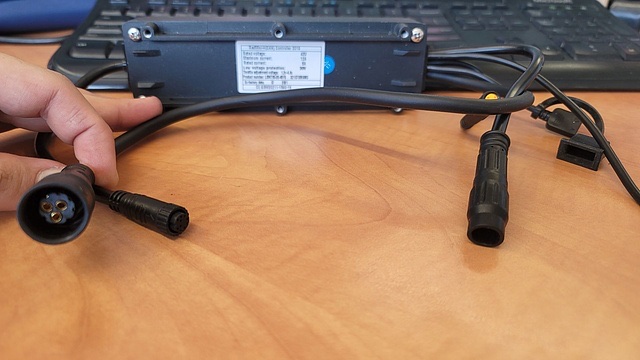 |
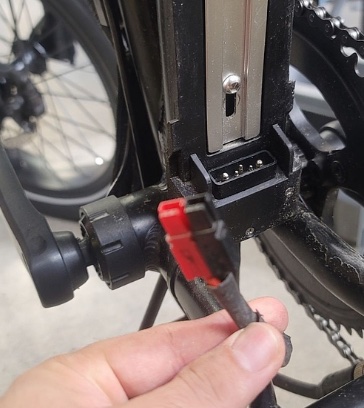
A round screw-lock plug under the battery cradle (usually 2 pins; we've also seen 5-pin versions), rather than a common connector like Anderson or XT60. | No adapter. With the battery removed, cut it off and crimp on Anderson Powerpoles. |
| Motor |  |
Most Rad hub motors (Bafang and Shengyi) use the octagonal Julet Z916. Some use a Z910 or a 3-pin plug, and at least one RadRunner had a plug that looks like a Z910 but isn't. | The L1019 to Z916 adapter, the Z910 to Z916 adapter, or the Phaserunner Z916 motor harness. |
| Brake levers and pedal sensor |  |
Small HiGo 2- and 3-pin plugs. | Usually rewired to the new controller or display. |
| Display | 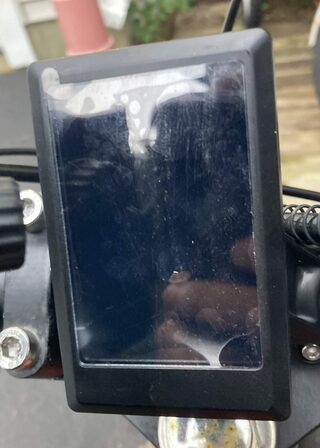 A RadBurro display |
A multi-pin plug (10 pins on some models) into a harness shared with the throttle, brakes and lights. The pinout isn't standard. | Replaced along with the controller. See below. |
Charging a Rad battery
Rad's 48V batteries charge to 54.6V, the same as our 48V batteries. Our basic 48V chargers have ST3 plugs, which don't fit a Rad's barrel jack, so you have two options:
- Basic replacement: any 48V lithium charger rated 54.6V with a 5.5mm barrel plug, including Rad's own. Check the voltage on its label (see the caution below).
- From us: the Cycle Satiator with the XLR to DC barrel adapter, whose pin fits both 5.5 x 2.1 and 5.5 x 2.5mm jacks. You can set it to stop at 80 or 90% for a longer battery life, or charge faster than the stock 2A. Keep the current at 5A or less. The Rad charge port has a 5A fuse, and 5A is about the most a DC barrel jack should carry anyway.
- Semi-integrated batteries (on bikes such as the RadRover 6 Plus and RadRunner 3 Plus): the battery keeps its charge port switched off until a charger connects, so a Satiator sees no battery voltage at first. Use its Force Start option to begin charging. A basic charger doesn't need this.
- Older RadMini and RadKick: these don't use the barrel jack, and we've seen XLR charge ports on early RadMinis. If yours has an XLR port, the Satiator plugs straight in. Send us a photo if you're not sure.
CAUTION: Never charge a 48V battery with a 52V charger. 48V and 52V chargers often use the same barrel plug, so a 52V charger will plug straight into a Rad battery and try to overcharge it, which can damage the pack or start a fire. Check the voltage on the label before connecting any charger you didn't buy for that battery.
If the fuse blows as soon as you connect a charger, the cause is almost always a short inside the battery's charge circuit or BMS, not the charger.
Replacing a Rad battery
Rad used two styles of battery: an external pack that slides onto a cradle on the down tube, and on newer models a semi-integrated pack that sits partly inside the frame. Both are 48V. A 48V replacement is the safe choice. Moving up to 52V is usually fine, and it's a good match if you're also moving to a Grin controller.
Capacity is a separate choice. Voltage sets top speed; amp-hours (Ah) set range. Our 48V downtube packs go up to 21Ah, half again the stock 14Ah.
Before you buy, look at the wires running from the battery to the controller. If there are only two, red and black, our batteries will run the bike with its original controller. If you also see extra signal wires, the bike may reject a replacement battery, so email us first.
In November 2025 the US Consumer Product Safety Commission issued a warning about Rad external batteries with model number RP-1304, RAD-S1304Y or HL-RP-S1304, printed on a label on the back of the battery. Rad says its Safe Shield and semi-integrated batteries aren't covered.
Our batteries won't slide onto the Rad battery cradle, and we don't modify our connectors to fit other companies' cradles. Here's what's involved instead:
- Mounting: remove the Rad cradle and bolt the base plate that comes with our battery to the frame's bottle mounts. Rad's mounting holes may not match the spacing of standard bottle mounts. If they don't line up, our Double Bob and Triple Bob battery anchors strap to the frame tube and give the plate a solid base.
- Wiring: our batteries use Anderson Powerpole connectors. Cut the round plug off the bike's battery lead and crimp on a pair of Andersons. Check the polarity with a multimeter before you plug in. WARNING: Take the battery off the bike before cutting any wires. Cutting a live lead can short the battery.
- Space: measure the gap first. Each battery page lists its dimensions, and on step-through and cargo frames the space between the tubes is often the limit. Allow about 5cm of extra clearance to slide the battery off its plate.
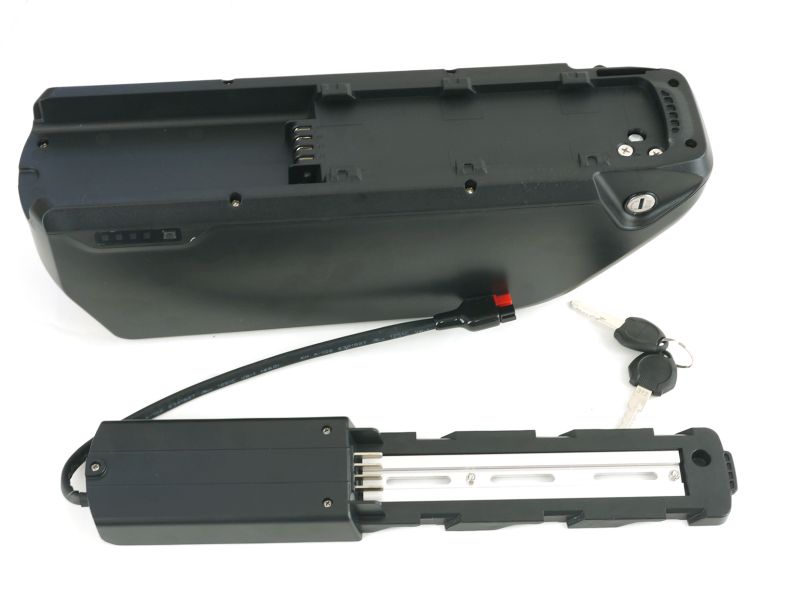
Our downtube battery slides off a base plate that bolts to the frame, and connects with Anderson Powerpoles.
If your Rad has a semi-integrated battery, our pack won't fit the battery cavity in the frame. It will have to go on a rear rack or on top of the frame tubes instead. Email us and we'll help you work out where.
Current isn't a concern. Factory controllers like Rad's typically draw at most 20 to 25A, well within what our downtube packs deliver, so the battery's BMS won't cut out.
We stock only packs with premium Panasonic or Samsung cells and a robust BMS, and we discharge-test each one to confirm its real capacity before it ships. The single biggest cause of battery fires is packs built with generic, no-name cells, so it's worth buying a battery whose cells you can be sure of. This video from Adam Savage's Tested shows what CT scans of over a thousand 18650 cells turned up.
Some of our packs are also UL 2271 certified, for buildings, transit systems and insurers that require it. We don't have evidence that they are safer or more reliable than our other packs, but they meet UL 2271's extra requirements for redundant BMS protection.
Batteries Rad owners commonly choose:
- 48V 15.5Ah downtube battery: closest to the stock 14Ah Rad pack.
- 48V 21Ah downtube battery: more range, UL 2271 certified.
- 52V 20Ah downtube battery: for use with a Grin controller.
Don't run two batteries in parallel without reading up first. Most packs, including ours, have a dual-port BMS, so one pack can charge the other through its unprotected discharge port.
For the general rules on replacing a factory ebike battery, see Battery Options.
Replacing the controller and display
We don't sell a plug-and-play replacement for the Rad display. Displays and controllers talk to each other with protocols that vary from maker to maker, and a display with a matching plug can still destroy components if the pins are wired differently. If you only want to see battery and speed information, the stand-alone Cycle Analyst works with every ebike ever made but will not offer the control aspects (speed control, power limits, etc.) without wiring modifications.
To get a bike with a failed display, controller or throttle running again, replace the controller and the parts that talk to it. Our Phaserunner and Baserunner controllers can run the motor on most Rad bikes. For the common Z916 motor plug, use the L1019 to Z916 adapter with an L10 Baserunner or Phaserunner, or the Z916 motor harness on a Phaserunner. Check your motor's plug against the table above first.
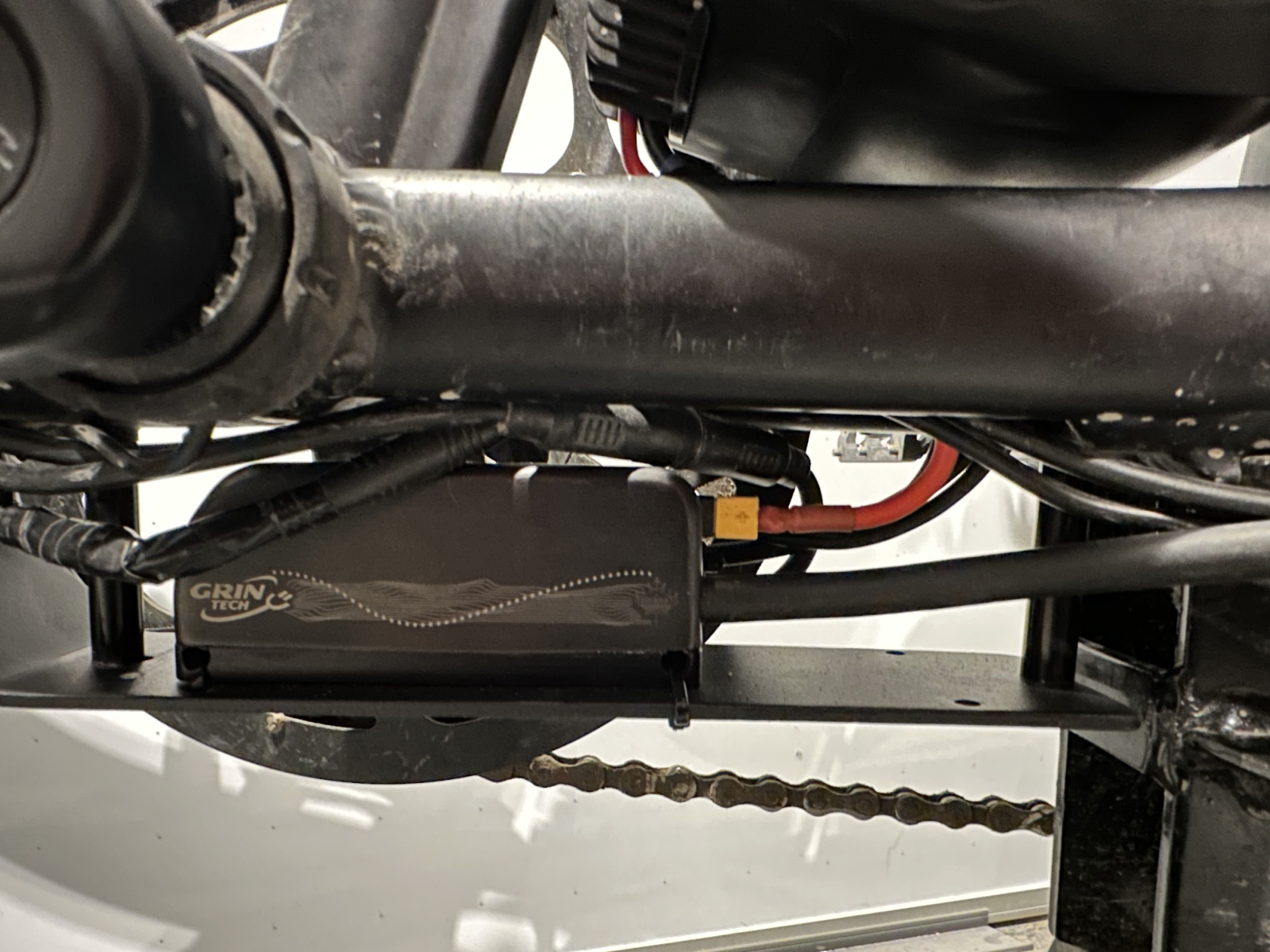
A Phaserunner mounted under a customer's RadRunner, running its stock Bafang G60 motor through our Z916 adapter. See the build.
You can keep your Rad battery with a Grin controller. With the battery removed, cut the round plug off the cable under the battery cradle and fit Anderson Powerpoles, as on this RadMini 4:
This is a project, not a part swap:
- The display is replaced by a Cycle Analyst V3, or by a display on our Superharness system (kit types explained).
- Throttle, pedal sensor and battery leads have to be matched to the new controller. Rad's original throttle may need rewiring to work with ours.
- The controller is set up with our free software and a programming cable, and tuned to your motor and battery.
What you gain: more torque from a higher phase current, and a higher top speed through the Phaserunner's field weakening, from the same motor and battery. The video below shows the whole job on a RadRunner.
We can't support every factory wiring variation, and damage from wiring mistakes isn't covered by warranty. If you'd rather not work out your bike's wiring, a complete kit is the simpler route.
A complete Grin kit
If the motor has failed, or you just want much more from the bike, the cleanest solution is a complete Grin kit. Your Rad battery can stay, with its plug changed to Andersons as shown above, or you can add one of ours.
For RadRunner, RadWagon and other fat-tire Rad bikes, the Grin All-Axle Max45 rear motor is the one that fits:
- Built for wide dropouts. Our 170mm quick-release adapters fit 170mm frames such as the original RadRunner directly. Some Rad frames, including the RadRunner Plus, measure 175mm, and on those a washer of about 2.5mm goes on each side.
- Torque sensor built into the freehub, so you get natural pedal assist with no bottom-bracket sensor to fit.
- Regenerative braking, and none of the clutch and gear wear of a geared hub.
- We stock fat rims in 20, 24 and 26 inch sizes, 65 to 90mm wide, as well as 650B and 700C rims. If your Rad uses a size we don't carry, such as 22 inch, the kit wheel will be a different size from your original.
- Check that your disc rotor clears the motor cable where it leaves the axle before you ride.
Measure your dropouts before ordering (how to measure). The rear Max45 Superharness kit includes the motor, Phaserunner controller, display and controls. Leave out the battery option if you're keeping your Rad pack.
For most riders the standard winding on a 48V or 52V battery is the right choice, good for about 27 to 28 mph in a 20-inch wheel, and field weakening can push that higher. The slow winding gives more low-speed torque for heavy cargo and steep hills.
Rad bikes our customers rebuilt
- RadWagon 3 rebuilt as the "GrinWagon"
- RadWagon with a Phaserunner, Manitoba
- Modified RadRunner, Calgary
- RadRunner daily commuter, Massachusetts
- RadMini 4 high-voltage build, California
- PlaidRunner: a first-generation RadRunner with a Max45 and Phaserunner (Endless Sphere)
- RadRunner Plus rebuild with an All-Axle motor (Endless Sphere)
Before you email us
We're happy to help you choose parts. To get a useful answer in one reply, please send:
- What failed, or what you want to change.
- Clear photos of the battery's charge port, the plug under the battery cradle, and the motor cable's plug.
- Your rear dropout width in millimetres, if you're considering a new motor.
Rad bikes vary even within a model name, so photos and measurements tell us far more than the model and year.